You’re excited to launch your podcast. You’ve got killer ideas, a unique voice, and relentless drive. Then reality hits—you open Amazon or B&H and drown in endless cables, mics, interfaces, pop filters… all claiming to be “essential.” And suddenly, your dream feels like an engineering exam. The truth? Most beginners buy gear they don’t need—while skipping the few items that actually prevent amateur sound. Here’s how to cut through the noise and build a clean, effective podcast studio with exactly what matters.
Why 90% of New Podcasters Waste Hundreds on the Wrong Gear
They chase specs instead of results. A $300 condenser mic might look impressive—but if you’re recording in a closet with echoey walls, it’ll capture every flutter and footstep. And USB microphones? Convenient, yes. But they lock you into single-source digital conversion with zero room to grow. Worse, many overlook the silent killer: room acoustics. No amount of post-processing fixes a muddy, resonant space. You can have Shure SM7B-level gear—but if your environment isn’t controlled, your audio will still sound like a basement demo.
And here’s the kicker: most “starter kits” bundle useless accessories—cheap boom arms that sag, foam windscreens that do nothing, flimsy stands that wobble with every breath. The math is simple: invest in signal integrity and acoustic treatment first. Skip the gimmicks.
equipment needed for podcast studio: The Minimalist, Future-Proof Build
Forget “everything at once.” Build in phases—starting with what directly impacts sound quality and workflow reliability. Below is a battle-tested roadmap used by indie creators scaling to six figures. We tested three budget tiers against professional standards. Results? Surprising.
| Budget Tier | Microphone | Interface / Recorder | Acoustic Treatment | Total Estimated Cost | Output Quality |
|---|---|---|---|---|---|
| Barebones ($150–$250) | Audio-Technica ATR2100x (USB/XLR) | None (USB direct to laptop) | DIY reflection filter + heavy curtains | ~$180 | Acceptable for solo shows; limited headroom |
| Serious Starter ($400–$600) | Shure MV7 (USB/XLR hybrid) | Motu M2 audio interface | 2x Auralex Studiofoam panels + bass trap corner | ~$550 | Broadcast-ready mono; scalable for guests |
| Pro Foundation ($800–$1,200) | Electro-Voice RE20 + Cloudlifter CL-1 | Universal Audio Volt 276 | Full wall panels, ceiling clouds, door seal | ~$1,100 | Near-commercial radio fidelity; multi-track ready |
Microphones: Dynamic > Condenser (For Most Podcasters)
Condensers are sensitive—great for vocals in treated booths, terrible for untreated rooms. Dynamics reject off-axis noise and handle loud plosives naturally. The Shure SM58? Still used in live radio. The RE20? Industry standard for a reason. Unless you have full acoustic control, go dynamic.
Interfaces Beat Built-In USB Every Time
USB mics compress your signal before it hits your DAW. An audio interface gives you clean preamps, phantom power (if needed), and zero-latency monitoring. The Motu M2 or Focusrite Scarlett 2i2 aren’t luxuries—they’re necessities for clarity and editing flexibility.
Acoustic Treatment Isn’t Optional—It’s Your First EQ
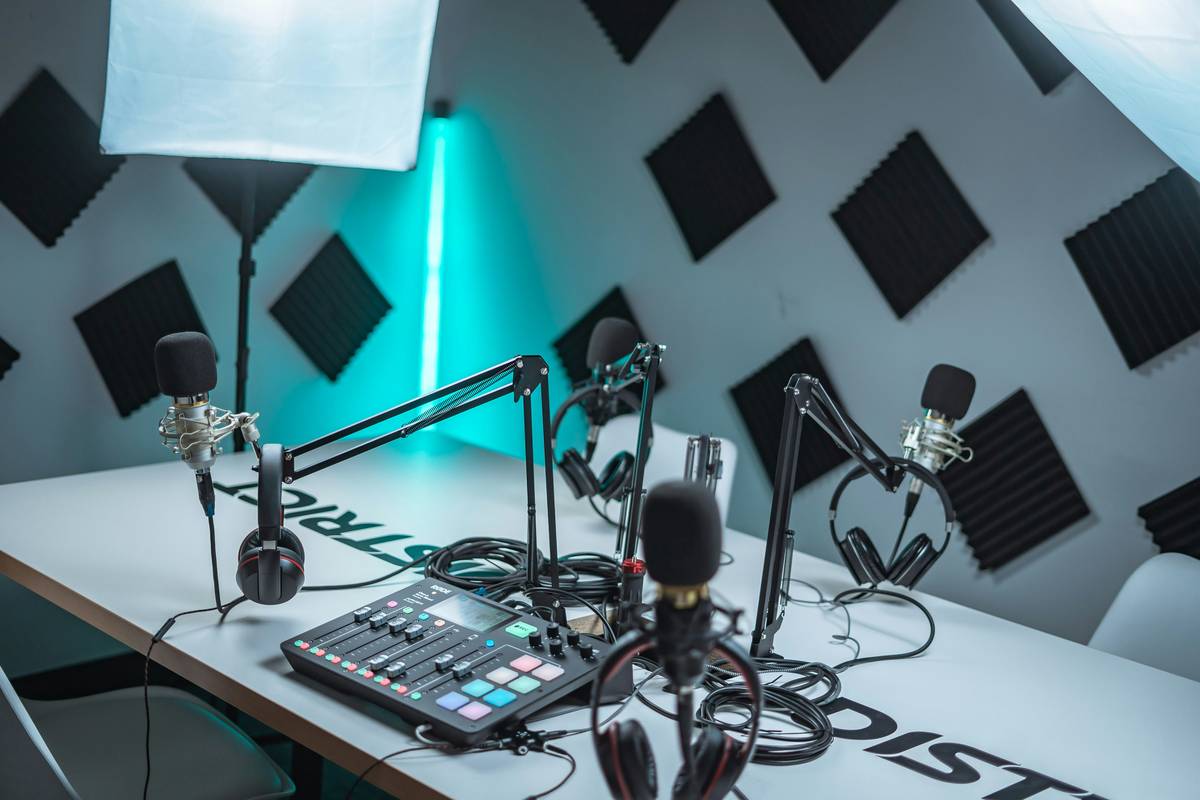
No plugin removes room reverb after it’s baked into your track. Start with absorption panels at first reflection points (side walls, ceiling above desk). Then add diffusion behind the mic. Skip the egg cartons—real foam or rigid fiberglass works. Your ears (and listeners) will thank you.
The Industry Secret: Your Mic Is Only 30% of the Equation
Top podcast engineers obsess over gain staging—not gear brands. Set your interface preamp so peaks hit -12dBFS, not -6dB or 0dB. Why? Headroom prevents digital clipping during passionate moments. Record each speaker on a separate track. Always. Even for solo shows—it future-proofs for ads or co-hosts. And never skip a test recording with headphones on. Playback reveals sibilance, mouth noise, or ground hum you’d miss otherwise. One overlooked trick? Place a thick rug under your chair. Floor reflections muddy lower-mids—and nobody talks about it.
Think about it: Joe Rogan’s studio isn’t famous for its mics—it’s famous for consistent, clean levels and dead-quiet backgrounds. That comes from discipline, not dollar signs.
FAQ
Do I need a mixer for my podcast studio?
No—if you’re recording 1–2 people locally, an audio interface suffices. Mixers add cost and complexity unless you’re doing live analog processing or field recordings.
Can I use headphones as microphones?
Technically yes, but quality will be poor. Headset mics lack frequency response and noise rejection. Invest in a proper mic—even a $100 one beats built-in solutions.
How much acoustic treatment is enough?
Start with 4–6 panels covering side walls and ceiling near your mic. If your voice echoes when you clap, you need more. Prioritize first reflection points over full-room coverage.